May 28th, 2007

How to temper chocolate
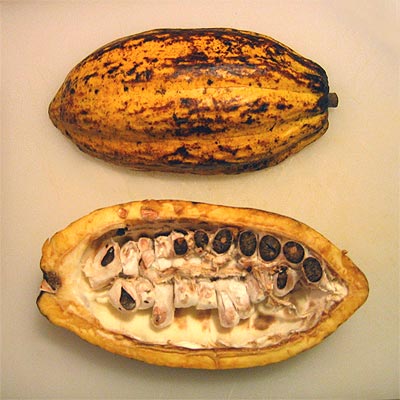
Coco&Me picture of a fresh cacao pod - open

(Picture: I purchased two fresh cacao pod several years ago during the National Chocolate Week. The shop assistant told me they are from Cameroon. I bought them for £7 each. Très expensive. But it was an experience to remember for sure! – One was for keeping to dry, & the other for cutting open. The fresh beans were acrid & I didn’t like the taste atall, but the white pulp surrounding them was sweet & exotic like I never ever tasted before.)
.

.

Here comes the big entry.
I am finally tackling this rather lengthy subject of tempering chocolate, after avoiding it for sometime…, shunning it under the carpet of “let’s write about easier things for now”.

.

But it’s become inescapable. I’ve already featured two recipes (ganache truffles, easter eggs & white chocolate wedding cake) in my blog requiring tempered chocolate to be used. Gotta press on with it, don’t I?

.

And besides, I had this impelling will to write this to give any assistance I can to the people looking for this type of information on the world-wide-web. – Because when I was self-teaching chocolate-making several years ago, I used to surf the web day-on-end to find useful introduction to tempering, but never had any luck! So maybe…, my contibution here would help out someone somewhere who’s in those same shoes I was back then!
.

One note to people new to tempering is that this technique is quite advanced. You’d certainly be practising this again & again. But don’t give up, don’t give up. You can use the same chocolate again to re-temper (unless it’s burnt). And cetainly don’t go spending silly money on automatic tempering machines which are notoriously temperamental.

After a dozen or so go’s, it’ll be written in to your body, straightforward like riding a bicycle, & you’ll be laughing about why it was so difficult in the first place.
.
– – – – – – – – – – – – – – – – – – – – – – – – – – – – – – – – – – – – – – – – – –

.

WHY :: The reason for tempering

.

‘Tempering’ is a word to describe the very particular method of controlling the temperature of your melted chocolate.

.
When you melt down chocolate, the chain of cacao butter crystals become intrinsically unstable and loses its neat formation. Controlling the chocolate with certain precise temperature (tempering) stablizes back the crystals that went haywire.

.

The chocolate with the temper treatment will have the most beautiful glossy sheen that screams sophistication & a crisp snap when broken.
.

Chocolate needs to be tempered if you want to use it as-is, or for moulding (de-moulding would be easier as the chocolate will shrink), for coating your bonbons, & making chocolate decorations.

.

If you allow your chocolate to solidify without tempering, or after inadequate tempering, you’d notice that you’d get the most aestheticly awful looking end-product with white streaks called ‘fat bloom’. Not only that, you yourself would be losing your ‘temper’ (excuse the pun! Had to say it didn’t I…) because it takes absolute ages to harden…

‘Fat bloom’ is a term used to describe the marks on your chocolate when the natural fat from the cocoa butter has displaced to the surface. Note it could also appear when you have nuts or nut oil in your bonbon filling. The nut oil will slowly migrate to the surface over time.

.

Please note that improper storage with high humidity would also un-temper your chocolate, & unapetizing marks such as ‘fat-bloom’ & ‘sugar bloom’ would appear on the surface.

‘Sugar bloom’ = the splotchy sweat marks after the chocolate had been in contact with moisture. The moisture dissolves the sugar present in your chocolate & when that dries, the dissolved sugar crystallizes leave marks behind. Also worth remembering that sugar bloom may occur when chocolate encounters sudden temperature fluctuations, such as when removed from the cold fridge & then left open in a room. This is because it condensates moisture from the air.

.
– – – – – – – – – – – – – – – – – – – – – – – – – – – – – – – – – – – – – – – – – –
.

With WHAT :: The indispensable equipments

.

  • Mixing bowls
  • Spatula
  • Digital probe thermometer, to constantly check the temperature of the chocolate. Once you’ve mastered tempering, you’ll ‘just’ know how the temperature of you chocolate is doing, & eventually & quite naturally this equipment will become redundant for you!
  • Marble slab, larger the better. In the kitchen where I did my short apprenticeship, they had a slab that was huge – like around A0 size – it was too heavy for me to carry. The size I use in my kitchen is A3 size, which I think is the minimum size you’re required to have to do tempering on. Anything smaller you’d be encountering lots of over-spilling from the sides. – If you’re finding getting a marble slab a problem (I got mine from the local run-of-the-mill household goods store), I have heard that alternatively, you can try use a very clean & dry stainless steel surface, that is, if you don’t mind the potential scratch marks!
  • Stainless steel scraper & palette knife for pushing, spreading & scraping the chocolate about on the slab. If you’re looking to purchase what the proffesionals use, try Keylink, a good UK supplier I’m constantly using for my chocolate making.
  • Double boiler. To initally melt down your chocolates & then to keep the tempered chocolate at a constant & optimum temperature while you’re doing your chocolate work, such as dipping your truffles. I use a machine called Caloribac (purchased from Keylink). And oh, please don’t waste your time with doing a bain-marie over your hob (although keep in mind that this is purely just ‘my’ opinion!). I’ve tried doing that, & I managed to spill water in to my bowl of chocolate when I clumsily handled the extremely hot bowl with my oven gloves. Doh! And you can forget about putting the bowl back on the hob to keep the tempered chocolate at a constant temperature – It’s really hard to gage precise temperature control over it. You’re likely to lose the temper & have to re-do the whole tempering process again…

.
– – – – – – – – – – – – – – – – – – – – – – – – – – – – – – – – – – – – – – – – – –
.

HOW :: The tempering methods

.

There are three methods.

The ‘seeding’ method.
The ‘icy water’ method.
The ‘marble slab’ (tablage) method.

.

x x x x x x x x x x x x x x x x x x x x x x x x x x x x x x x x x x x x x x x x
.

The ‘seeding’ method:

.

Note, for this you need a supply of tempered chocolate, as the whole idea of the method is to introduce (‘seed’) stable cacao butter crystals to unstable liquid chocolate.
.

1. Put aside 1/3 of the chocolate & melt the rest. Melt until the temeprature of the liquid reaches:

55 ºC (130 ºF) for dark chocolate
45 ºC (110 ºF) for milk chocolate
40 ºC (100 ºF) for white chocolate

.

2. Take it out of the double boiler in to a mixing bowl.

.
3. Deposit the 1/3 you kept aside.

.
4. Slowly mix it in (so as not to create air bubbles in your mixture). Constantly keep check on how the temperature’s doing. You need the temperature to go down to the following numbers before using it for your chocolate work:

27 ºC (81 ºF) for dark chocolate
26 ºC (79 ºF) for milk chocolate
25 ºC (77 ºF) for white chocolate

.

x x x x x x x x x x x x x x x x x x x x x x x x x x x x x x x x x x x x x x x x

.

The ‘icy water’ method:

.

It’s a good way to temper on a Summer’s day when the kitchen is too warm.

.

1. First melt all your chocolates to the following temperatures:

55 ºC (130 ºF) for dark chocolate
45 ºC (110 ºF) for milk chocolate
40 ºC (100 ºF) for white chocolate

.

2. Take it out of the double boiler in to a mixing bowl.

.
3. Place this bowl in a larger bowl with cold water & ice. 10 to 20 seconds at a time. It’s a good idea to place a pastry ring or anything similar in the water bowl for the chocolate bowl to rest on so that it doesn’t slip around & risk pouring water in to your chocolate by mistake.

.

4. Spatula constantly, especially the sides & the bottom of the bowl where it cools quicker.

.
5. Bring the temperature DOWN to the following:

27 ºC (81 ºF) for dark chocolate

26 ºC (79 ºF) for milk chocolate

25 ºC (77 ºF) for white chocolate

.

6. Then place your chocolate bowl over another bowl of warm water, approx. at 35 ºC (95 ºF). Do this to bring the temperature UP to the following. Make sure you don’t go over the suggested figures or you’ll lose the temper:

30 – 32 ºC (87 – 89 ºF) for dark chocolate
29 – 31ºC (85 – 88 ºF) for milk & white chocolate.

.

x x x x x x x x x x x x x x x x x x x x x x x x x x x x x x x x x x x x x x x x
.

The ‘marble slab’ (tablage) method:

.

1. First melt all your chocolates to the following temperatures:

55 ºC (130 ºF) for dark chocolate
45 ºC (110 ºF) for milk chocolate
40 ºC (100 ºF) for white chocolate

.
2. Take it out of the double boiler in to a mixing bowl.

.
3. Pour 2/3 of it on to your marble slab. (Leave the remaining 1/3 in the mixing bowl. – Make sure you spatula down the sides of the bowl, you don’t want to have thin layers of chocolate drying up on the sides of the bowl as you work on your marble)

.

4.
Using your palette knife, spread it across your marble.

.
5. Use both palette knife & scraper to bring the chocolate in to a mound in the middle again to keep the temperature of the mass uniform.
.
6. Repeat steps 4 & 5 (spread & regroup) while constantly checking the temperature. (If you’re fortunate to have a large marble slab, you’ll be tempering much quicker if you try shifting your scraping work from one end of the slab to the other. That way you’d always be using the cool surface that hadn’t been warmed up with chocolate yet!) Make sure you’re not introducing air bubbles to the liquid as you work it.
.
7. Bring the temperature down to the following:

27 ºC (81 ºF) for dark chocolate
26 ºC (79 ºF) for milk chocolate
25 ºC (77 ºF) for white chocolate

.

8. Pour back this chocolate in to the bowl where you’ve left the other 1/3. (At this point you’ve got to work quickly. The chocolate is rapidly cooling down as we speak!)
.

9. Slowly mix the two mixtures with your spatula. Make sure you thoroughly mix.
.

10. After mixing, the chocolate should reach the following temperature:

30 – 32 ºC (87 – 89 ºF) for dark chocolate
29 – 31ºC (85 – 88 ºF) for milk & white chocolate
.

x x x x x x x x x x x x x x x x x x x x x x x x x x x x x x x x x x x x x x x x
.

Top Tips:

.

Take time melting your chocolate. There are 6 elements to cacao butter crystals, which has different melt points, & you want to make sure you break it all down. You’ll also get a thinner coating on your bonbons.
.

Don’t go over the suggested temperatures when melting. The cassein & the milk protein in the chocolate will burn. And don’t go too low than the suggested temperature when you’re doing your chocolate work either – you’d end up with a layer of coating that’s too thick.
.

Never artificially cool the marble slab, as it’ll get too cold. Tempering must be done by gradually cooling.

.

Remember, the temperature & the humidity in your kitchen would seriously play a big part. Forget tempering in the Summer unless you’ve got a room cooler.

.

I personally find the ‘icy-water’ method risky & fiddly. Not only there’s the danger of getting the water in the chocolate, the temperature of your chocolate becomes very uneven.

.

Do use couverture, chocolate with real cacao butter, with atleast 31% of it – do not ‘coating chocolate’.

.

It’s fiddly to temper a small amount of chocolate. Atleast half a kilo is required.

.

A good way to test wether you’ve tempered correctly is to dip a clean knife in to it & pop it in the fridge for half a minute. If you see a set coat of shiny chocolate, you’ve got it right!

.

x x x x x x x x x x x x x x x x x x x x x x x x x x x x x x x x x x x x x x x x
.

Well, I hope it’s been of any help… Good luck… As for me, I’m off to bed…

May 13th, 2007

Coco&Me Wedding Cake 01

cocome_weddingcake01.jpg

(Three tiered chocolate butter cake with raspberry ganache layer. Coated in pâte à glacer, & decorated with couverture slabs)

cocome_weddingcake02.jpg(I wish I could show you what the inside looks like… Obviously, I can’t cut in to it… Now I know I should’ve taken a picture of a slice when I did the test-bake…!)
.
Last Thursday I made a 3-tier wedding cake for Sue’s daughter Hannah. Sue has a stall close to mine, & she is one special lady, always looking out for me, buying cakes from my stall when times are tough on a rainy day, & always when she has guests that weekend. She would also bring me all sorts of “finds” that I might like (& I do!) from car boot sales & fairs. Cake plates, vintage cadbury’s toy car, chocolate moulds, vintage childrens books for my boy, beautiful vintage cake pillars… I really like her. Don’t get me wrong, it’s not because she gives me things! It’s because she is a warm person, & I think it’s important to have nice people like her around you, to remind you to mellow out & breathe a bit, because there’ll be someone there for you. And so I was honoured to be asked to make the wedding cake for her daughter. I’m happy that my first-ever wedding cake (which means so much to me) goes to such a good home!
.

Yesterday Sue & Hannah gave me the most wonderful gift. The cake stand that Hannah used for her wedding! I couldn’t believe it. The stand had been in their family for a very long time apparently, & it was Hannah’s strong wishes that it be used for her wedding cake. To give me such a special stand that means so much to them… I was honoured, & moved.

.

Do you remember I did a test-bake of it earlier this year? (check this link out to read a post from that time). Well, finally it was the time to do it – & the good thing is, I was not nervous about it atall, thanks to that test-bake. I knew exactly what to do, how long it’ll take, & importantly, how delicious it tastes. I tell ya, it’s just miles better than the traditional fruit cake kind (yuk, I never liked ’em) with overly thick icing that sticks to the back of the teeth.

.

Here is the recipe for the Coco&Me Wedding Cake. (although unfortunately, I do not have the ‘process pictures of it as I promised to do – Sorry guys, maybe next time – I just did not have the time nor the will to tinker with a camera on a big baking mission like this – especially when I had the pressure of meeting the deadline of 7pm handover!)
.

For bakers who would rather not have the trouble of tempering your own chocolate slabs, I think a good alternative is to use store-bought chocolate thins such as ‘Jules Destrooper Chocolate Thins’ or anything rectangular!

.

Some top tips when baking:

– Please read through the recipe thoroughy beforehand. That way there’ll be no surprises!
– If you do not have a 6 inch tin, do what I did – bake in a smallest that you do have (I had a 7 inch one) & cut a 6 inch cake out of it! Just remember to increase the recipe abit to compensate for it!
– And if you want to know about how to successfully whip egg whites, or how best to cream the butter, click this link for a thorough write up about it.
– Always buy some extra eggs! Just incase you brake one by mistake…
– Make sure your eggs are also at room temperature. Adding ‘straight out of the fridge’ cold yolk &/or cold meringue in to your cake mix would seize it up!

.

x x x x x x x x x x x x x x x x x x x x x x x x x x x x x x x x x x

.

Feeds: 25 to 30 people
Difficulty: Intermediate, if you substitute the chocolate slabs with something else such as store-bought chocolate thins.
Time to make: 3 to 5 hours (it depends on how competent you are at baking!)

.

x x x x x x x x x x x x x x x x x x x x x x x x x x x x x x x x x x

.

CHOCOLATE SLAB RECIPE:
Before you bake the sponges, make enough chocolate rectangles, clingfilm them & store in the refrigiator. I used over 60 slabs for the decoration. But I made alot more to make sure I had enough to hand ‘just incase’. The measurement was 3cm x 8.5cm.

.

To make the slabs:

1. Temper 1kg white couverture.
2. Pour it on to a big sheet of clingfilm that’s crease-free, layed out on your table. Spatula the chocolate surface to 3 or 4mm thickness.
3. When semi-set, use a sharp knife & a clean ruler to cut to size.

.

x x x x x x x x x x x x x x x x x x x x x x x x x x x x x x x x x x
.

THE CHOCOLATE SPONGE RECIPE:

.

Ingredients:

450g unsalted Butter – room temperature
450g dark Chocolate – melted
160g castor sugar (for step 3 in the recipe)
23 egg yolks
225g almond powder
egg whites 23 eggs worth
300g castor sugar for mixing with the egg whites to make meringue

450g plain flour
.

You will need the following items:

6inch (15.2cm) round springform baking tin
8inch (20.3cm) round springform baking tin
10inch (25.4cm) round springform baking tin
Cake cards for the three sizes – It has to be thin, not drums.
18 x thin wooden BBQ skewers cut precisely to 8.5cm high
2 x extra large mixing bowl
3 x cake racks
A long piece of clean string for tying around each tier to support the slabs while it sets

.

And prepare these before your baking frenzy:

Pre-sift the flour.
Have the chocolates melted in a seperate bowl.
Preheat oven to 180 degrees.

Butter the baking tins. Sift flour in to it so that it sticks to the bottom & the sides. Tap out excess flour, & store the prepared tins in the refrigiator until needed.
.

Method:

1. In a large mixing bowl, cream the room temperature butter.
2. Pour in the melted chocolate. Constantly whisk while doing so.
3. Whisk in the sugar.
4. Whisk in the egg yolks.
5. Whisk in the almond powder.
6. In a seperate bowl, make stiff meringue (To read up on how to obtain a perfectly whisked up meringue, click here).
7. Fold half of the meringue in to the cake mixture from step 5.
8. Sift in all of the flour & fold.
9. Next fold in the rest of the meringue.
10. Divide the cake batter in to the three cake tins.
11. In to the 180 degree oven it goes. (Pre-heated ofcourse!)
12. The ‘bake time’ for each size tin will be different. Because of this, you’ll be taking the tins out at different times. Please use the following as a guide, but please also do a ‘skewer test’ (inserting a skewer in the centre to see if it comes out clean).

6 inch = take out after 30 minutes

8 inch = take out after 50 minutes

10 inch = take out after 1 hour

13. When baked, take the tin sides off & cool them completely.

.

x x x x x x x x x x x x x x x x x x x x x x x x x x x x x x x x x x

.

RASPBERRY GANACHE FILLING RECIPE:

.

80g unsalted butter (room temperature)
1000g dark chocolate (preferably 70% cocoa solid, in button form for quick melt, or finely chopped from a bar – although bear in mind that chopping it up takes more time to do than you think)
800g fresh double cream
200g raspberry jam

.

1. Boil the cream in a pot.

2. Pour hot cream over the chocolate & the jam in a mixing bowl.

3. Leave to stand for 10 seconds. Then use your spatula to mix it in slowly from the centre, incorporating more cream from the sides as you do it.

4. Mix in the butter. Mix until it dissolves (if you still have lumps left, give it a 5 second wiz in the microwave).

.

x x x x x x x x x x x x x x x x x x x x x x x x x x x x x x x x x x

.

Pâte à Glacer (coating chocolate) Recipe:

.

2kg White couverture chocolate
160g pure vegetable oil

.

1. Melt chocolate in a mixing bowl.

2. Add oil. Mix together.
3. Place the mixing bowl in a ice filled water bath & keep stiring the chocolate/ oil mix with your spatula. Make sure you stir from the bottom of the bowl, where it is most cold. Keep stiring til it thickens.
4. Place the bowl in a hot-water bath for a very few seconds to bring the temperature up again.

5. Now it is tempered for coating the sponge.
.

x x x x x x x x x x x x x x x x x x x x x x x x x x x x x x x x x x
.

CAKE ASSEMBLY:

.

1. Cut cake in to two horizontally, & sandwich 5mm layer of the raspberry ganache.

2. Put the sandwiched sponge on a cut-to-size cake card.
3. Place the first sponge to be coated on a cooling rack, on top of a clingfilmed tray.

4. Pour some pâte à glacer over the cake. Smooth it down the sides, to cover it completely.

5. Sit down. Get comfortable. Take your time sticking one slab at a time to the side of the cake. Make sure to overlap each one slightly. Once you’ve stuck it all on, tie a string around it to support them. Now is your chance to really make sure each slab is straight. When you’re happy, pour more pâte à glacer in the centre of the sponge & let it fall down to all the sides. This would help fill any gaps inbetween the sponge & the slabs.

6. Repeat these steps for the other two tiers. Note, you can re-use the pâte à glacer that had fallen to the tray again to cover the next sponge.

7. Once you’ve done all three, next skewer some wooden sticks in to the bottom two layers. These would act as plinths to hold the weight of the next tier up. More skewers mean more stability, but also means lots of holes on your slice. Placing nearer the outskirt also gives you stability, but make sure it is not visible when assembled. Place one in the middle, & then symmetrically skewer in a circle.
8. Finally tower up your tiers & et voila! Phew… sit back, you can relax now, & enjoy the monumental view, possibly with a beer because you deserve it!
.
x x x x x x x x x x x x x x x x x x x x x x x x x x x x x x x x x x

March 29th, 2007

Parisien macarons (& ganache filling)

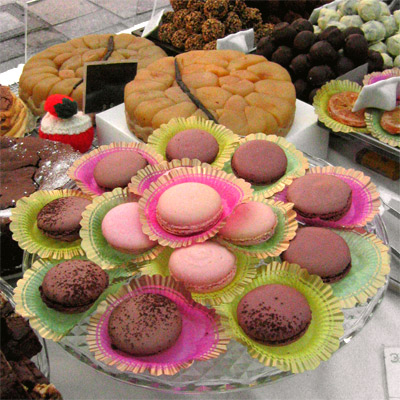
handmade macarons made by Coco&Me - sold at Broadway Market, East London

(The paper discs make the display colourful despite it being only two types of Macarons!)

.

Macarons. Macarons. The Heavenly Macarons.

.

They are what dessert foodie’s Heaven is made out of. Delectable morsels that have a smooth domed surface, which encases a texture that can only be described as soft, gooey, slightly chewy… Mmmm… Which you’d be munching slowly… savoring every bite… with the ganache chocolate centre combining in your mouth… Mmmm… But then… will be finished before you know it! Ahh… Just imagine Homer Simpson’s drooling passion for his Donuts – that same passion applies to me about Macarons…

.

I sell pink Macarons (with raspberry jam + ganache centre) & chocolate Macarons (with dark ganache centre) at my stall. I would love to sell many different coloured ones, as one of the attractions of these morsels is the array of colours it could come in, irresistably displayed like cute buttons. But work-time-wise, I am at my limit. I already make more than ten types of cakes every week, & chocolate truffles, etc, on top of that… Pink & chocolate colours are by far the most popular at the market it seems, so I’ll stick to those colours for now!
.
So without further ado, here is the recipe(s) for Macarons.
I’d be explaining the base recipe which you’d use to create any colour Macaron you’d like. And then I’ll also list the ingredients list for Chocolate Macarons, which requires you to swap some of your almond powder with cocoa powder.
.
Warning:
… … This dessert is very difficult to master. A perfect Macaron MUST have ‘THE FOOT’ which is the raggedness around the edges. It mustn’t come out cracked. It must be round. Each Macaron must be of same size.
… … So I’m afraid it’s all about trials & tribulations! I’m yet to meet anyone who’d made it perfectly from their first go. It took me numerous attempts with recipes from many sources to get it looking alright enough for me to sell. To have to try again & again til perfection is a test of endurance for your love of Macarons. Just remember, every single step in the recipe is important, otherwise, sorry to say, you’re doomed for failure.
… … Also, please remember that everyone’s oven is different. Is it fan or convection, is it pretty old & not precise with temperature, does it have heat spots… (I have a heat spot on the right for example). Every oven has it’s own knack. So I recommend the use of an oven thermometer! This little biscuit requires preciseness.
.
Although despite these warnings, please don’t be intimidated by its complexities. Try! & besides, you’d always be able to eat them test batches for yourself, right!? (Like I do). Surely no harm done… ;-)
.
x x x x x x x x x x x x x x x x x x x x x x x x x x x x x x x x x x

.
Macarons Recipe:
Makes approximately 16 sides (but all dependent on how big you pipe it)
.
Ingredients:

  • 50g Almond powder
  • 90g Icing sugar
  • Liquid food colouring (optional)
  • (and for the meringue the following:)
  • 60g Egg whites (about 2-3 eggs worth), at room temperature
  • 30g Icing sugar
  • For the centre: jam, buttercream, or ganache (5:4 ratio of cream & chocolate. Read below for the recipe)

.
Prepare:
a. Sift almond powder & the icing sugar TWICE. It’s your chance to get rid of the not-so-fine almond powders.
b. Line baking tray with cut-to-size baking paper (or prefably a silpat if you’ve got one). Place this tray on top of another tray (Doubling up the tray delays the heat cooking the Macaron from the bottom. This insures that the outer surface is dried up first before the inside starts to lift it up. This is what makes that all important ‘foot’ & the smooth surface that is not cracked).
c. Have a piping bag ready.
.
Method:

  • 1. Whisk the egg whites with the icing sugar. Whisk until stiff peaks.
  • 2. (Optional) Add food colouring (Literally droplet at a time, as these droplets paint the whites unapetizingly vivid if you’re too generous. But also remember that the colour intensity will be slightly less once you incorporate the dry ingredints later!). Mix it in to the whites.
  • 3. Deposit the pre-sifted dry ingredients (almond powder & icing sugar) in to the white in one go.
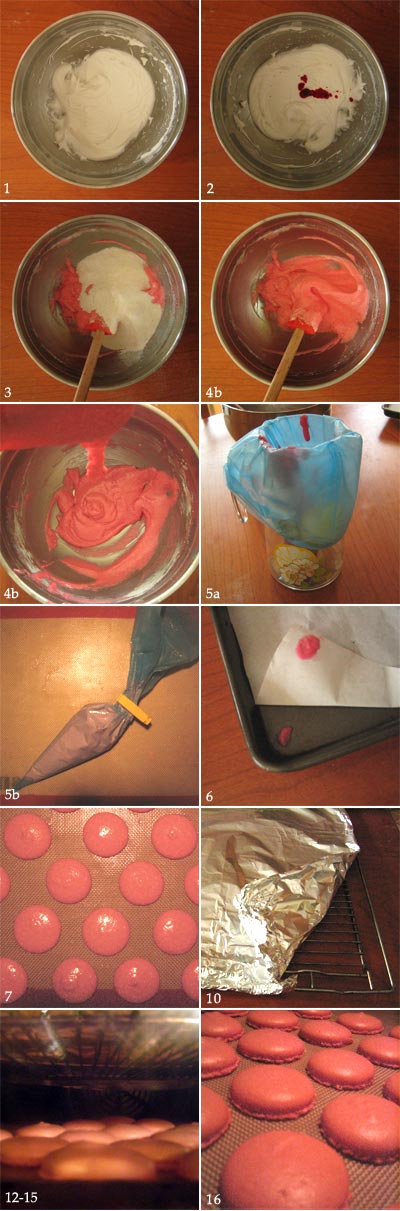
  • 4. Use the spatula to fold it in. Once all the dry ingredients has been incorporated & dissapeared, you must check wether you’ve reached perfect consistency. Test by lifting up the dough with your spatula – HOW DOES THE DOUGH FALL? If it is not falling down in ‘GENTLE’ continuous ribbons, try mixing it a tiny bit more. The technique for mixing at this point is to “fold & press” your spatula against the side of the bowl to deflate the air out of the whites. Do this til you’ve passed this vital ‘dough fall’ test. But just remember, don’t over mix it either… (This folding process is called ‘macaronage’. This is the most tricky bit of Macaron making. I find that you can only know how much one should fold by practising again & again…)
  • 5. Spatula the mixture in to a piping bag. (tip: having the bag over something like a juice decanter like the picture below is much easier than the professional way!)
  • 6. (skip this if you’re using silpat) Scrape the left over mixture from the now empty mixing bowl & smear it under all four corners of the baking paper. It’ll act as a glue to stick the paper to the tray.
  • 7. Pipe 3-4cm rounds on to the baking paper. Make sure to leave atleast 2cm around it as it will spread later.
  • 8. Once all piped, drop the tray horizontally on to your work surface to knock some air bubbles out & to spread the dough out a bit. (If you’re doing this at night, & you’re worried you’d wake your kid upstairs (for example), layer some kitchen towels on the work surface to dumb the sound!)
  • 9. Leave it aside for 20-30 minutes. This is to dry the surface of your macarons. After the time is up, check how dry it is by gently touching the surface. Does the dough stick back? Leave it aside for another 10 minutes. Once it’s not sticky, proceed to the next step.
  • 10. Prepare your oven shelves – you’d want to place your trays on middle shelf. I’d like to cover the shelf above it with foil so that there’s no direct heat hitting my Macarons & discolouring it brown.
  • 11. Pre-heat oven to 190 degrees.
  • 12. Pop your trays in. (Make sure they are doubled up!!) Sit by your oven with your oven gloves.
  • 13. Once ‘the foot’ graciously appears (it’s usually after 4 – 5 minutes), & has reached it’s maximum height, open the oven & quickly but safely take the bottom tray away (meaning don’t double it up anymore). Place the macarons tray back in the oven.
  • 14. Change the temperature dial to 170 degrees.
  • 15. Bake it for another 5 – 7 minutes. If the colour of the surface is starting to brown, turn the oven off, keep the door shut, & bake it with the remaining confined temperature.
  • 16. Leave aside to cool together with the hot baking tray.
  • 17. Once cooled, you’d have to remove it off the baking paper. To do this, you dab water on the baking paper under each Macaron & wait a few seconds. The paper should peel off easily without giving. Just do this process slowly & patiently – these Macarons are delicate stuff (if you’re using silpat, just use a knife & slide them off). Now, you can either go to the next step, or decide to store these discs in a consealed tupperware – it’ll keep for several days.
  • 18. Pair up the Macarons.
  • 19. Pipe the ganache centre mixture (Please read the ganache recipe below) or any other mixture of your choice & sandwich the Macarons together.
  • 20. Place in a tupperware & store it in a refrigerator.
  • 21. Best eaten the next day!

.Step by step photo of the Macaron making process
x x x x x x x x x x x x x x x x x x x x x x x x x x x x x x x x x x
.
1:1 Ganache centre recipe:
.
Ingredients:
50g of fresh double cream
40g of dark chocolate
1. Have the chocolate ready in a mixing bowl.
2. Heat cream in a smallest saucepan you have. Bring it to simmering point
3. Pour the hot cream over the chocolate.4. Leave to stand for 10 seconds. Then use your spatula to mix it in – SLOWLY – from the centre, incorporating more cream from the sides as you do it.
.
x x x x x x x x x x x x x x x x x x x x x x x x x x x x x x x x x x
.
Chocolate Macaron Recipe:..Ingredients:
45g Almond powder
90g Icing sugar
5g Cocoa powder
Red liquid food colouring
(and for the meringue the following:)
60g Egg whites (about 2-3 eggs worth), at room temperature
30g Icing sugar.Method:
Please follow the basic recipe above. The red food colour will add that extra richness to the chocolate colour. To make green tea Macarons, you can user the same measurements as this – just swap cocoa to green tea powder, and omit the red colour.
.x x x x x x x x x x x x x x x x x x x x x x x x x x x x x x x x x x.
“AHHH. Donuts Macarons… What can’t they do.” – adaptation quote from Homer Simpson…!
.Update 20.06.07

ps: Which is the correct way to spell – macaron or macaroon? The original french version is ‘macaron’. But the english version seems to be ‘macaroon’… Pronounced with the ‘oo’ too. But doesn’t that point toward the American Coconut Macaroons…, not the French kind? If anybody knows, please advise me!!

March 4th, 2007

Luxury Brownies (the secret recipe)

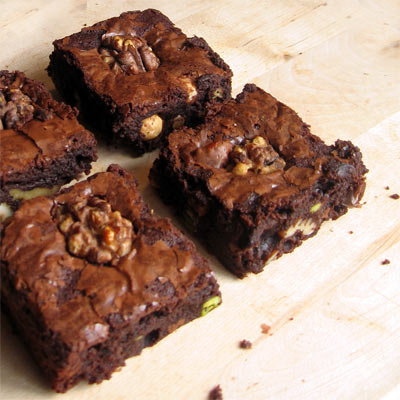
Luxury Brownies - homemade by Coco&Me.

Dearest readers, this week I’d like to share with you my secret recipe for BROWNIES that I sell on my stall.

.

The Brownies War:

As you can imagine, brownies being so popular, there are many stalls selling them at my market (I counted ten stalls/ shops). It’s big headed of me to say this I know, but, I’m proud to say that mine always sell-out no problem. I make tonnes of it too – about 30 chunky slices per week – & on a week when I know the business will be good (ie: sunny weekends, & Christmas weekend), I make 40 – 50 slices, & they still go.
Because of this, I briefly debated wether to share this recipe online like this, but…, what the heck, I’ve got enough ‘regulars’ devoted to mine, & it’s competitively priced. Even if someone do a copycat, I’m confident that it won’t affect my sales!
.

The history of Brownies:

Obviously, the name comes from the colour of this cookie/ cake. The origins, on the otherhand, is uncertain – but folklore has it that it was created by accident by a careless cook who’d forgotten to add baking powder to the chocolate cake. (Many origins of cakes are invented by careless cooks! Tarte Tatin was also created similarly.)

The first brownie recipe was published by Fannie Merrit Farmer in 1896, which calls for a nut tobe embedded in the centre. All early brownies contained chopped nuts too.

.

x . x . x . x . x . x . x . x . x . x . x . x . x . x . x . x . x . x . x

.
LUXURY BROWNIES RECIPE

.

These brownies are ‘seriously’ the BEST. I can assure you. Wanna know why? Because it’s got plenty of delicious nuts (pistachio, walnuts, hazelnuts, pecans) in them, & it is double chocolatey, as it uses both cocoa & solid chocolates in the recipe – which is unusual, when most recipes call for just ‘either or’.

.
Texture: moist, dense & fudgy.
Difficulty: easy as pie.

.
Ingredients:
230g Butter, roughly cubed
310g Sugar
(Granulated or Castor)
200g Whole eggs (approximately four) whisked up
230g DARK Chocolate
– in small pellet form or chopped finely so it melts quickly (very important)
140g Flour
40g Cocoa Powder

200g of nuts of your choice (pistachio, walnuts, hazelnuts, pecans – You can use just one type or use all four types like I do. They add different crunchy textures to every fudgy bite, which makes the brownie interesting til the last bite)

20cm square baking tin
.

Prepare:

a. Butter the baking tin. Then line the bottom & the sides with baking paper.

b. Sift together the flour & the cocoa powder.

c. Have the chocolates ready in a large mixing bowl.

d. Leave aside some nuts to decorate the surface of the brownies with (in my opinion, walnuts look best).

e. Preheat oven to 180 degrees.

.

Method:

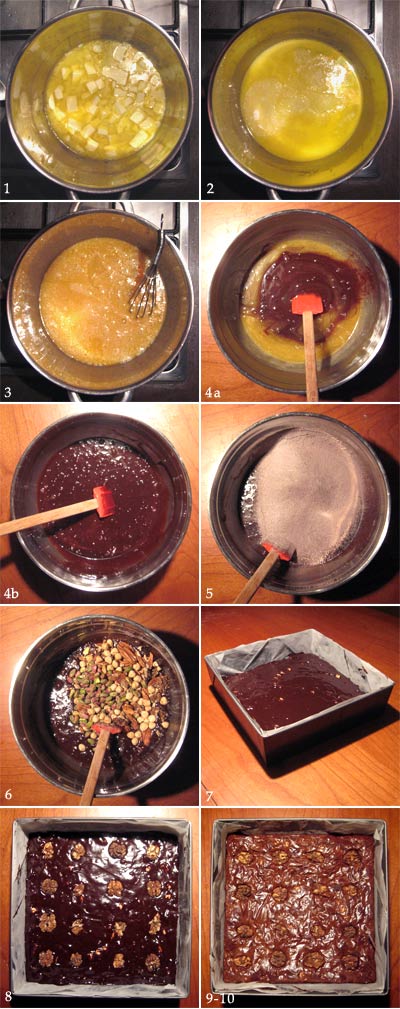
1. Melt the butter completely in a large pot.
2. Add the sugar. Dissolve.
3. In a separate mixing bowl mix the solid chocolates & eggs (make sure to mix well).

4. Pour the piping hot mixture (from 2) over the chocolates/eggs in a bowl. Mix quickly & thoroughly – make sure all the chocolates have dissolved (if you still have lumps of chocolates left, zap it at 10 second intervals in the microwave until it melts).

5. Spatula in the flour & the cocoa powder. Mix until no traces of flour can be seen.
6. Mix in the nuts. (Make sure you leave some aside for decorating the top with).
7. Pour the mixture in to the prepared tin.
8. Evenly decorate some more nuts on the top surface.
(Make sure each slice would have a decorative nut)
9. Bake in the oven (that has been pre-heated to 180 degrees) for 18 to 22 minutes. It’s cooked when the edges have gone slightly dry, the top is shiny & has cracked. The centre of the brownie shoudn’t be wobbly when shook. Remember: the toothpick method won’t work on this fudgy brownie!
10. Leave aside to cool. Don’t cut until they’ve reached room temperature, or even better leave it untouched for a WHOLE DAY to rest – I can promise you, it’ll taste better tenfold.

.

Brownies recipe explained in image sequence.

Note:

This recipe is versatile – instead of nuts, you can put pretty much anything in there – like dried fruit such as dried cherries, or fresh fruits like raspberry. Baking is meant to be fun & so don’t go out-of-your-way to buy the nuts if you haven’t got it (as nuts can be expensive). Use whatever that is in your store cupboard & experiment! like, be creative with sliced almonds & spell a letter on the surface!

.

x . x . x . x . x . x . x . x . x . x . x . x . x . x . x . x . x . x . x

January 22nd, 2007

About sugar (with vanilla sugar recipe)

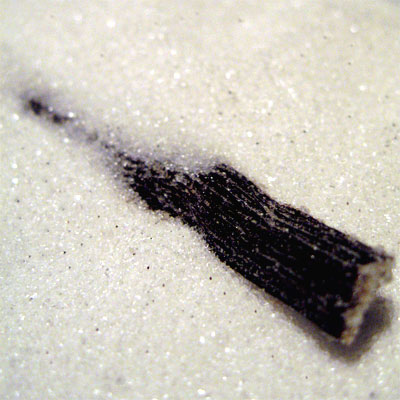
Home made vanilla sugar with vanilla pod

(Home made vanilla sugar)

.
Sugar is a staple in everyones kitchen, & is used extensively in confectionery. Obviously it is sweet, but it’s more than that – it provides moisture, tenderness, enhances other flavours, provides stability in meringues, can caramelize, can even be bitter & increases shelf-life (A good example is jam. High percentage of sugar prolongs shelf life as it inhibits the bacteria to grow). But did you know that there are dozens of varieties of it available? It’s a minefield. It can be mystifyingly confusing… Before my obsession with baking I don’t think I ever used anything other than white refined granulated sugar!
.

So here is a list of some of the sugars. I think it’ll help understand why your recipe is calling for a particular type, & have confidence in switching it when you want to have a more caramelly flavour for example:

  • Granulated ::::: Very versatile, all-purpose sugar but one-dimensional in flavour. No aroma, so it’s great when you just want to have the ‘sweetness’ & pronounce the flavour of the other ingredients such as chocolate in a chocolate cake. – If a recipe doesn’t specify which sugar type to use, it’ll be safe to use granulated.
  • Castor ::::: Selectively sieved from the granulated sugar. It’s known as caster sugar because it is suitable for placing in a ‘caster’, a perforated jar or a bottle, similar to a flour dredger.
  • Icing ::::: It rapidly dissolves even in cold water. A must when you make meringue for macaron. Also great for dusting it on top of your finished product. It is made by grinding sugar to a very fine powder. A small amount of anti-caking agent (for example 3% cornstarch) is often already added to it to prevent clumping.
  • Preserving sugar ::::: Often used for jam making, it has the largest crystals that dissolves slowly which makes it less likely to burn the sugar as it does not settle in the bottom of the pan. It also reduces the need for stirring. Less froth is also produced resulting in a clearer preserve.
  • ‘Golden’ caster or granulated sugars ::::: Molasses is ‘painted’ to the white sugars to add the light golden colour & aroma. Slightly more flavourful than the white.
  • Demerara::::: Free-flowing crunchy crystals. Also good for sweetening beverages such as coffee.
  • Light/ Dark Brown ::::: Based on caster sugar. The molasses is ‘painted’ to give it colour & give depthy, fudgy flavour. (In some cases ‘food colour’ is painted on instead of molasses, to recreate the delicious brown look.) It’s moist, & it gives extra tenderness to the cake. Make sure to not let it dry out & it’ll be hard like a rock.

All of the above can be substituted with each other in principal. They come from the same stage of sugar process, & some are just that they are various crystal sizes depending on what you’d like to use it for.

The confusing part is… some of these can come as refined (bleached, refined white sugar which is pure sucrose/ carbohydrate), partly refined, or unrefined (typically 50% less processed than refined. It retains some of the natural properties, making it wholesome & healthy). It could be under naming such as ‘natural’ or some brands call theirs differently. You really have to study the package before purchase.

  • Light/ dark Muscovado::::: Unrefined natural sugar. Strong tasting natural molasses flavour. Brown & sticky. More unprocessed than Turbinado Sugar.
  • Turbinado::::: Unrefined. Similar in appearance to brown sugar with molasses flavour but paler & course granulation. Often used in tea. This sugar can’t always be substituted in recipes. Its moisture content varies considerably which can affect a recipe. You’d have to carefully adjust other ingredients such as the liquids.
  • Unrefined Soft Light/ Dark Brown::::: Distinctive caramel taste. Light & dark soft brown sugars can be replaced with one another only in small quantities. If you do, the cake will not turn out like you wanted it to, because the flavour & moistness is different between the two.
  • Molasses ::::: Dark syrup extracted during sugar manufacturing. Only a little is needed as it is very concentrated. Not as sweet as sugar. Replace no more than half the sugar called for in a recipe with molasses.

The following are the natural sweeteners:

  • Honey ::::: Distinctive flavour that varies depending on which flower nector the bees have been gathering. Generally, honey can be used in place of granulated sugar, it’ll make the cakes moist & dense. But watch out, it is 25 – 50% sweeter than sugar & tend to brown faster. So experiment with using less of it, it is said that you should use the amount of honey that is equivalent to ½ the amount of specified sugar, reduce liquid ingredients by ½, & reduce the oven temperature by 25 ¼ F.
  • Maple syrup ::::: Could be made from the maple tree sap, or artificially made with maple flavouring. Look for the word ‘pure’ when choosing. It has fewer calories & higher concentration of minerals than honey. Keep refrigerated and consume within 6 to 8 months.

And then for sweetening the chocolate ganache:

  • Invert sugar & Glucose Syrup ::::: It is highly effective in preventing crystallization, & so makes the mixture smoother with better viscosity. It is not as distinctively sweet or flavourful like the other sugars which is great when you rather want to pronouce the flavour of the chocolate itself. But inverted sugar is almost impossible to get if you are a home-user (it only comes in big multi-kilogram tubs) so try honey as a substitute.
  • Trimoline ::::: It is produced from beets. It emulsifies the fat, & prevents recystallization of sugars. It smoothes the texture & increases shelf life by retaining moisture. It has a sweetening power of 128%.

.

History:
Sweet tasting liquid from the Sugar cane (a tropical grass) was first discovered on the islands of the Pacific Ocean some 20,00 years ago (!) but the process of making sugar by evaporating its juice developed in India around 500 BC. It is from then on that the technology for sugar production slowly spread around the world, although for many hundreds of years, sugar was a highly prized and expensive ‘spice’ that was used only in the homes of nobility and royalty, just like the history of chocolate.
.
I recently came across the most insightful historic literature of how sugar was refined & then manufactured into loaf sugar back in 1876 London (loaf sugar was refined white sugar moulded into cone-shaped loaves – which then got cut up either by the retailer or at home using a cleaver & then pounded to powder). I love the way it’s written. Its not just an account of what it was like, but more like a good novel. It describes one of the workers as a creature with chest all grizzly-haired, calls it the ‘Sugar Ogre’ in waiting for juvenile delinquents. – It’s a bit long, but persist. I found that it was worth reading.
.
x x x x x x x x x x x x x x x x x x x x x x x x x x x
.

Home-made Vanilla Sugar Recipe:
Vanilla sugar is simply castor sugar with vanilla. There are no set rules of how to make it. If you want, you can change the ratio of sugar/ vanilla according to wether you’d like the aroma to be intense or subtle. And you can keep replenishing more sugar in to the same jar & the pod would sufficiently flavour the sugar.

.
Ingredients:
200g Granulated or castor sugar (any amount is okay – it just lessens or increases the aroma of vanilla, thats all)
1 x Fresh or used vanilla pod (There are two ways to go about it. To use pod skin & seeds, or just pod skin after you’ve used the seeds for other baking requirements)
Container with tightly fitting lid (I find it is pretty when white sugar has dark specks of pure vanilla seeds, so I recommend a clear glass jar!)

.
1. Chop the vanilla pod – for example, in half. If you’re using fresh pods, de-seed & then chop.
2. Place both sugar & vanilla pod (& seeds) in the jar & mix well, distributing the vanilla beans in the sugar.
3. Tightly seal with lid & store in a cool place. The sugar would be gorgeously scented in 1 to 2 weeks. It will keep indefinately without refrigeration.

.
Uses:
Use the vanilla sugar in baked goods & desserts that calls for both sugar & vanilla. Or sprinkle over home-made sponge cakes, biscuits, fresh fruit, custards, crème brûlée, crumbles, favourite breakfast cereal, hot coffee, milkshakes, yoghurt, buttered toast etc.

.
x x x x x x x x x x x x x x x x x x x x x x x x x x x
.
This week:
I have been busy in the evenings making Chocolate Valentines Hearts for the oh-so-busy Valentine season that’s creeping it’s way.
And my son has started nursery on Wednesday! A milestone. A bit of a tear jerker. It’s 1pm til 3.30pm, Monday to Friday. You’d think that it’ll give me more me-time, but it takes me 30 minutes to walk there, so by the time I walk him & go back home, it’ll only give me 1½ hours at home before I go & pick him up…!

« Previous Entries   Next Entries »